Poultry lighting is one of the simplest tools a farm can use to improve bird welfare and performance. Yet many farms still rely on old fluorescent lamps or uneven homemade setups. Good lighting does much more than brighten a barn. It shapes behavior, growth, and production.
In this guide, we break down what poultry lighting is, how it works, and how to set up a reliable system in your farm. Whether you manage broilers, layers, or breeders, understanding light will help you run a more efficient house.
What Is Poultry Lighting?
Poultry lighting refers to LED systems designed specifically for chickens. These systems use controlled intensity, smooth dimming, and animal-friendly spectra to support natural behavior and production.
Chickens do not see light the same way humans do. They are sensitive to flicker, spectral shifts, and uneven brightness. A lamp that looks fine to us may be stressful to them. Poultry lighting solves this with:
- Flicker-free LEDs
- Balanced red/white/green/blue spectral combinations
- Smooth 0–100% dimming
- Uniform distribution across the barn
These elements help the flock stay calm, eat consistently, and develop in a healthy way.

Why Poultry Lighting Matters
Improves Growth Performance
Broilers grow better under stable light. Soft, uniform light encourages steady feeding and reduces aggression. In early life stages, birds respond well to green and blue wavelengths, which support muscle development.
Enhances Egg Production
Layers depend heavily on photoperiod. Proper day length and red spectrum help the reproductive system work at its best. Many farms see higher laying rates once they switch to controlled LED lighting.
Supports Animal Welfare
Bright spots and dark corners cause uneven behavior and sometimes fear. Flicker—often invisible to us—creates stress. A good LED system reduces these issues. Birds stay calmer, making the barn safer and easier to manage.
Reduces Energy and Maintenance Costs
LED poultry lights use far less energy than fluorescent tubes. They also last longer, especially in hot, dusty barns. Fewer replacements mean less disruption for the flock.

Improves Farm Management
Predictable lighting helps birds follow consistent routines. Feeding, resting, and movement become more regular. This stability makes overall farm operations easier.
Understanding Poultry Lighting Spectrum
Not all colors of light affect chickens the same way. A well-designed poultry lamp uses a mix of wavelengths to support different goals.
Red Light
- Encourages laying
- Helps activate the reproductive system
- Useful in laying houses and breeder houses
Blue Light
- Calms birds
- Helps during catching or transportation preparation
- Often used for broilers
Green Light
- Supports early growth in broilers
- Helps improve weight gain during the first weeks
Full-Spectrum White
- Natural-looking
- Good all-purpose light for daily activity
- Works well in mixed houses
Every farm has different needs. Broilers, layers, and breeders respond best to different spectral balances. This is why specialized poultry lights exist.
Lighting Requirements for Poultry Houses
Light Intensity
Different houses need different lux levels:
- Broilers: 5–20 lux
- Layers: 10–30 lux
Too much light causes stress. Too little causes inactivity.
Uniformity
Birds should not chase shadows. Even coverage prevents piling, fighting, and uneven growth.
Flicker-Free Output
This is essential.
Chickens see flicker far more sharply than we do. Any flicker—often from cheap drivers—makes birds nervous and jumpy.
Smooth Dimming
Sunrise and sunset simulation keeps birds calm. Abrupt changes cause panic. A good system dims from 0 to 100% with no visible steps.
Durability: IP, IK, Ammonia Resistance
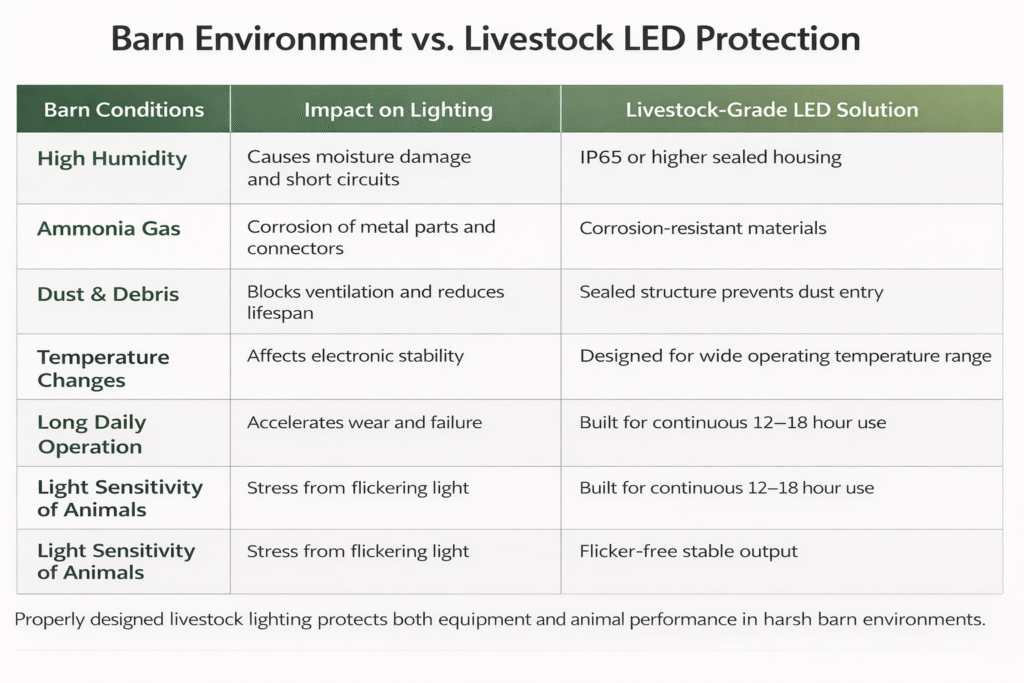
Chicken houses are harsh. Lights must handle:
- High dust levels
- Ammonia exposure
- Washing and disinfection
- Constant vibration
For most farms, IP65+ and ammonia-resistant housings are recommended.
How to Set Up Poultry Lighting (Simple Guide)
Switching to LED does not have to be complicated. Most farms can upgrade quickly with the right system.
Choose the Right Fixture
Tube lights are the most common choice because they spread light evenly and are easy to mount. Some houses use hanging fixtures or integrated panel lights, depending on ceiling design.
Plan the Layout
Lighting height and spacing matter.
Tube lights are usually installed in one or two rows, depending on house width. Make sure the entire area receives consistent brightness.
Use Plug-and-Play Connectors
Modern systems—like AmberAgri’s—use male/female connectors. No hard wiring inside the barn. This reduces installation time and improves safety.

Install Clip Mounting
Clip mounting is simple. Mount the clips first, then snap the light in. This makes replacement and maintenance faster without disturbing birds.
Set Up Dimming
Use a controller that supports:
- Day/night cycles
- Ramping up and down
- Emergency lighting
- Uniform dimming across all rows
Maintenance Tips
- Check dust buildup every few months
- Ensure connectors remain tight
- Replace individual tubes if brightness drops
Recommended Poultry Lighting Solutions (Reference Only)
These brands offer reliable poultry lighting systems:
HATO (Netherlands)
Known for scientific research and premium designs.
Hontech-Wins (China)
Well-known for poultry dimming and waterproof tube lights.
ZALUX (Spain)
Strong durability and ammonia resistance.
AmberAgri (China )
Soft flicker-free light, easy installation, plug-and-play connectors, and fast clip mounting.
Ideal for farm upgrades or new barn projects.
Conclusion
Good poultry lighting is a long-term investment. Proper light intensity, spectral balance, and smooth dimming improve welfare and productivity. Whether you manage broilers or layers, a modern LED system helps create a more stable environment and reduces your operating cost.
If your birds are showing uneven growth, poor laying performance, or nervous behavior, lighting may be the simplest place to start improving results.
Contact us now for more information
FAQ
1. What spectrum is best for layers?
Red and warm white light support laying performance and stable photoperiod control.
2. How many lux do broilers need?
Most broiler houses operate between 5 and 20 lux, depending on flock age and management style.
3. Can I use normal LED bulbs?
Not recommended. Regular bulbs flicker and lack correct spectra. Poultry-specific LEDs work far better.
4. How long should lights stay on for layers?
Layers typically need 14–16 hours of light, depending on breed and production goals.
5. Do I need dimming?
Yes. Smooth dimming reduces stress and helps birds transition between day and night.